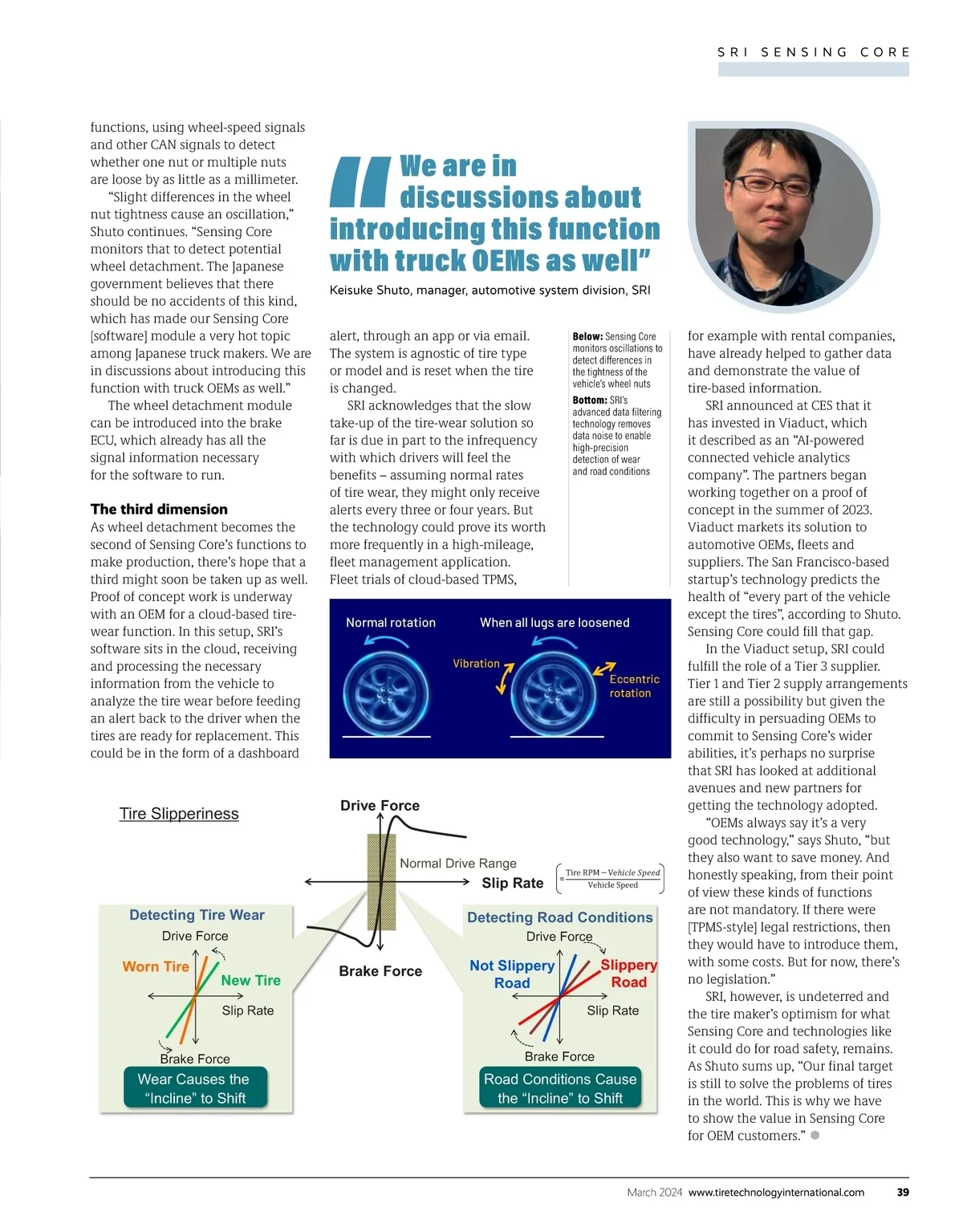
SRI SENSING CORE functions, using wheel-speed signals and other CAN signals to detect whether one nut or multiple nuts are loose by as little as a millimeter. “Slight differences in the wheel nut tightness cause an oscillation,” Shuto continues. “Sensing Core monitors that to detect potential wheel detachment. The Japanese government believes that there should be no accidents of this kind, which has made our Sensing Core [software] module a very hot topic among Japanese truck makers. We are in discussions about introducing this function with truck OEMs as well.” The wheel detachment module can be introduced into the brake ECU, which already has all the signal information necessary for the software to run. Below: Sensing Core alert, through an app or via email. monitors oscillations to The system is agnostic of tire type detect differences in or model and is reset when the tire the tightness of the vehicle’s wheel nuts is changed. Bottom: SRI’s SRI acknowledges that the slow advanced data filtering take-up of the tire-wear solution so technology removes data noise to enable far is due in part to the infrequency high-precision with which drivers will feel the detection of wear and road conditions benefits – assuming normal rates of tire wear, they might only receive The third dimension alerts every three or four years. But As wheel detachment becomes the the technology could prove its worth second of Sensing Core’s functions to more frequently in Detachment a high-mileage, Mechanism of Wheel detection make production, there’s hope that a fleet management application. third might soon be taken up as well. Fleet trials of cloud-based TPMS, Proof of concept work is underway with an OEM for a cloud-based tire-Normal rotation When all lugs are loosened wear function. In this setup, SRI’s software sits in the cloud, receiving Vibration and processing the necessary Eccentric information from the vehicle to rotation analyze the tire wear before feeding an alert back to CORE the driver when the SENSING Principles (Wear & Road Conditions) tires are ready for replacement. This Cultivated years of DWS development, our advanced data filtering technology could be in the over form 25 of a dashboard removes data noise to allow for high-precision detection of wear and road conditions. “ We are in discussions about introducing this function with truck OEMs as well” Keisuke Shuto, manager, automotive system division, SRI Tire Slipperiness Detecting Tire Wear Drive Force Worn Tire New Tire Slip Rate Brake Force Wear Causes the “Incline” to Shift for example with rental companies, have already helped to gather data and demonstrate the value of tire-based information. SRI announced at CES that it has invested in Viaduct, which it described as an “AI-powered connected vehicle analytics company”. The partners began working together on a proof of concept in the summer of 2023. Viaduct markets its solution to automotive OEMs, fleets and suppliers. The San Francisco-based startup’s technology predicts the health of “every part of the vehicle except the tires”, according to Shuto. Sensing Core could fill that gap. In the Viaduct setup, SRI could fulfill the role of a Tier 3 supplier. Tier 1 and Tier 2 supply arrangements are still a possibility but given the difficulty in persuading OEMs to commit to Sensing Core’s wider abilities, it’s perhaps no surprise that SRI has looked at additional avenues and new partners for getting the technology adopted. Drive Force “OEMs always say it’s a very good technology,” says Shuto, “but This is more for trucks, but some don’t have WSS at each axel. they also want to save money. And Normal Drive Range Tire RPM - Veℎ honestly speaking, from their point = Vehicle Speed Slip Rate of view these kinds of functions are not mandatory. If there were Detecting Road Conditions [TPMS-style] legal restrictions, then Drive Force they would have to introduce them, with some costs. But for now, there’s Slippery Not Slippery Brake Force no legislation.” Road Road SRI, however, is undeterred and Slip Rate the tire maker’s optimism for what Sensing Core and technologies like it could do for road safety, remains. Brake Force As Shuto sums up, “Our final target Road Conditions Cause is still to solve the problems of tires the “Incline” to Shift in the world. This is why we have to show the value in Sensing Core 14 for OEM customers.” March 2024 www.tiretechnologyinternational.com 39
Tire Technology International March 2024 Issue : Page 39